Before, all the attention was consolidated on TV, but then came the revolution of mobile phones and people’s attention fragmented and shifted onto phones. However, their consumption patterns are still from the TV era, and they still impact what we view on our mobile phones.
Since two months, I have been biting my nails figuring out how to get a skip rate under 35% because I was making dry content related to the software that I am making and how I am gaining followers for it. Only one video got a skip rate below 35% in it, and it got me like 120K views as of now. And I have been trying to chase the same thing again. I tried restructuring my scripts to be just exactly like that video, trying to copy the visual elements, trying to copy the same clip. I have done a lot, but still, it didn’t work. But now I just uploaded a video where I am talking about the business of drugs, and that shit got a 31% skip rate out of nowhere. It was such a low effort video.
And then I realized, “Hey, there is a pattern here.” In India, there are like 3-4 crime shows that get a lot of attention. In the USA, there is “Crime and Order” and other series. Globally, this category has a lot of weight behind it. The audience is trained to watch it because we have been seeing the same content since we were kids, and it is also a validated market because who wouldn’t be curious about those things? And that’s why so many production houses made those shoes.
Then I got to think about it in soap operas or dramas – what we see is the day-in-day-out life or whatever things are happening with a character and the people around them. And that’s exactly what day-in-the-life or vlog videos are. It’s like on television we had an archetype, internet fragmented attention away from TV and got it to the internet, but still the same content consumption patterns are there and they are rewarding their newer re-born archetypes.
We will see business shop owner posting their videos, and it kind of resembles pawn shop from history tv. We see video essays and informative content popping up on the internet, and then I remember National Geographic or Discovery TV which had stuff like that. Every once in a while, we would watch on television some person being applauded because of their achievements, and that’s the exact thing that happens on reels. Someone might post their achievements, but only a few of them get attention, while others are just knobbed away. It’s not like we have an appetite to watch a lot of that content, so we can learn a lot from how television segmented their shows – how much of what to show to your customers to retain their attention.
Show them a bit of daily life, history, crime, business, some other people’s achievements, a bit of nature, and they will stay tuned. That was the philosophy old TV houses had, and I think we should try to figure out what chunks or proportion were allotted to each of the different categories and figure out the attention market that exists in humans. I think the TV networks had kind of done that for us.
You know why factual things burn out? Because people just don’t have brains for it. You can not have only factual content on your channel. I see Indian news channel runs behind-the-scenes content for soap operas or runs some shabby paranormal-type documentary during afternoons because only tired grandparents and housewives are at home. Kids are at the school and husband are at the office. The target audience of news is just not there. So even they play spicy shit despite they are supposed to be purely factual and informative.
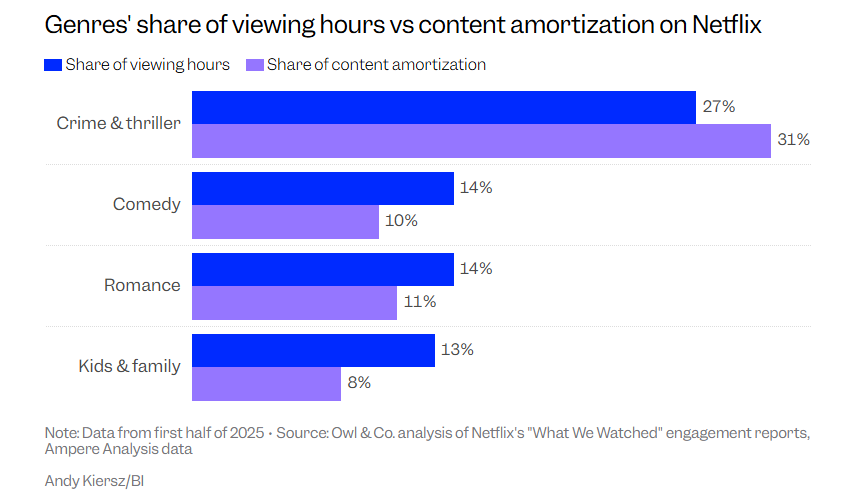
This data is from Netflix and just shows how big the crime and thriller genre is. I guess that explains why every other video on my feed is conspiracy or something funny.

This is old data, but we can still see how people don’t really care much about reality or biography or talk shows or even documentaries. Like I said before, they don’t care about the information. If they did, they would be hating the books and Wikipedia. They are here to feel something. They are here for the drama and the comedy. So if your content is purely about yourself or your journey, I don’t think that’s sufficient because of the consumption pattern that people have. You gotta have some drama and comedy going on, and you don’t have to be the joker for it. You can discuss situations, people, and other things in your niche that you can talk about it in that way. In the funny and dramatic way.
While these two data sources might have categorized crime and drama in different ways. I don’t think I have a clear conclusion if people have a heavy favor for true crime. But the main point is clear that people want something that is dramatic and funny. Information won’t do much for you.
What you should be doing is to go out there and figure out how you can create content that is a bit dramatic, funny, and thriller for your niche. You can talk about certain case studies that make people’s heads turn or certain incidences that are very interesting. You will have to borrow from the world when it comes to the subject of your video, but the lens of analysis should be what your niche is about. If you are a psychology girly, then go explore cases where anxiety resulted in a person doing something that became a huge incident. You can also talk about a huge incident and how it might have been caused because of anxiety. The beauty of using case studies or incidences is that you can analyze it from any lens. The drama, the thrill, and the suspense of the situation itself is transitive. So even if your niche is boring, your lens is boring, the case itself will make it very interesting. And sometimes, even just talking about the entity or concept that exists can be interesting enough.
This does not deny the existence of outliers. I know certain philosopher channels do get a lot of views, but so did Bear Grylls. He captured the attention on television, even though it was a small subset of the overall attention and so did some other niche creators on internet. But how much share of attention did they actually capture? Do you wanna make a bet that you’re just going to have an outcome like them or do you wanna play the optimal strategy?
From Claude
The formula you’re describing:
- Borrow drama from the world (the case study/incident provides inherent entertainment value)
- Apply your niche lens (your unique perspective/expertise becomes the analysis framework)
- The drama is transitive (the suspense transfers to your topic, even if your topic is “boring”)
For different niches, this looks like:
- Software/SaaS creator: Don’t talk about “growth hacking tactics” → Analyze “How Duolingo’s passive-aggressive owl generated $500M in revenue” (your lens: viral marketing psychology)
- Psychology girly: Don’t explain “types of anxiety disorders” → Examine “The trader who lost $6.2B because he couldn’t admit a mistake” (your lens: loss aversion and anxiety)
- Fitness coach: Don’t demo “proper squat form” → Investigate “Why CrossFit gyms have a 50% injury rate” (your lens: biomechanics and ego)
- Finance bro: Don’t teach “portfolio diversification” → Expose “How Archegos lost $20B in 2 days and banks are still lying about it” (your lens: risk management)
| TV Archetype | Core Psychology | Internet Equivalent | Examples (TV) | Examples (Internet) |
|---|---|---|---|---|
| Crime/Investigation | Justice, mystery-solving, moral clarity, voyeurism into darkness | True crime videos, business exposés, “dark side of” content, investigative journalism | Law & Order, CSI, CID, Forensic Files | Coffeezilla, Internet Historian investigations, “The Dark Side of [Industry]” videos |
| Soap Opera/Serialized Drama | Parasocial relationships, emotional investment, “what happens next” | Vlogs, day-in-the-life, ongoing creator narratives, relationship content | Kyunki Saas Bhi, Days of Our Lives, This Is Us | Emma Chamberlain vlogs, family channels, ongoing business journey content |
| Situational Comedy | Comfort, routine, escapism, relatability | Comedy sketches, relatable humor shorts, slice-of-life funny moments | Friends, The Office, Sarabhai vs Sarabhai | Khaby Lame, sketch creators, “POV” comedy, relatable memes |
| Reality/Competition | Vicarious ambition, schadenfreude, rooting interest, drama | Challenges, “I tried X for 30 days”, competition content, transformation journeys | Indian Idol, Big Boss, Survivor, The Bachelor | MrBeast challenges, fitness transformations, “I learned X in Y days” |
| Educational/Documentary | Curiosity, learning, wonder, understanding how things work | Video essays, explainers, “how X really works”, deep dives | Discovery, National Geographic, How It’s Made | Veritasium, Johnny Harris, Vox Explainers, Aperture |
| News/Current Affairs | Staying informed, civic duty, tribalism, being “in the know” | Commentary channels, news breakdown, hot takes, current events analysis | CNN, NDTV debates, 60 Minutes | Philip DeFranco, news commentary, political YouTubers |
| Talk Shows/Interviews | Celebrity access, wisdom, intimate conversation, gossip | Podcasts, interview content, “in conversation with”, Q&As | Koffee with Karan, The Tonight Show, Oprah | Joe Rogan, Hot Ones, podcast clips, interview channels |
| Game Shows | Play-along engagement, wish fulfillment, testing knowledge | Trivia content, interactive polls/quizzes, “can you solve this?” | Kaun Banega Crorepati, Jeopardy, Family Feud | Riddle channels, “only 1% can answer”, interactive story content |
| Sports | Tribal loyalty, excellence, live drama, peak human performance | Gaming streams, sports highlights/analysis, esports, competitive gameplay | Live cricket, NBA, commentary shows | Twitch gaming, sports analysis channels, esports tournaments |
| Lifestyle/How-To | Self-improvement, aspiration, practical value, aesthetic pleasure | Tutorials, “get ready with me”, recipe videos, DIY, productivity content | MasterChef, home improvement shows, fashion TV | Recipe creators, productivity YouTubers, aesthetic TikToks, how-to channels |
| Kids/Family Programming | Nostalgia (adults), developmental needs (kids), safe entertainment | Unboxing, toy reviews, kid-friendly challenges, educational content | Cartoon Network, Sesame Street, Disney Channel | Ryan’s World, CoComelon, kid gaming channels, educational animations |
| Variety Shows | Novelty, surprise, “something for everyone”, unpredictability | Mixed-format creator content, reaction videos, compilations, “Reddit reads” | Saturday Night Live, Ed Sullivan Show | Reaction channels, commentary + clips, variety content creators |