Well, this might be the third or fourth time I’m mentioning about the business cycle. For me, there are five steps in a business cycle:
- To pay money to find work
- To pay money to get that work done
- To pay money to get that work delivered
- To get paid for that work
- To reinvest it into step one
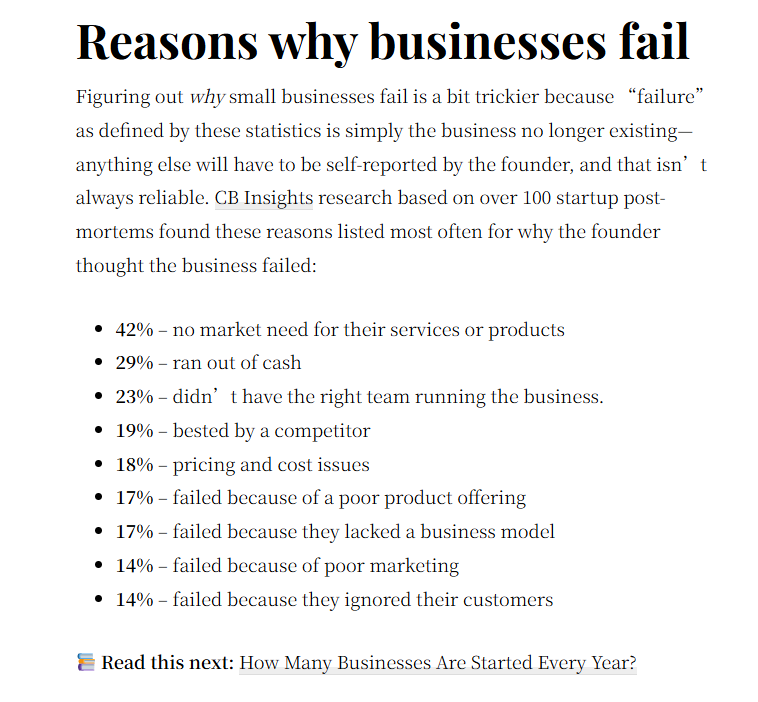
I was reading the Commerce Institute report, and according to them, if you start a business, there is a 35%+ chance that you will survive till the 10th year (for most businesses and some even have a 40%+ chance.). I have faced odds worse than that. So doesn’t really scare me, but the reason behind failure kind of does. According to the same report, 42% of the businesses fail because there is no market need for whatever goods or services they have. Competitor, cash, bad partners or whatever are not nearly as strong as a factor as the demand.
That means businesses are actually going bust because they are not able to carry out the fifth step, which is to reinvest into finding more work, but if there is no work, then the cycle just stops. 42% fail because they didn’t have any demand and 21% fail because they ran out of money. It might be because their margin shrank too much and step 2 or 3 got unviable. But again, step 2 and 3 going unviable downstream means you cannot do step 5.
Basically, the main reason businesses are dying is that they are not able to find work for themselves. Either because work doesn’t exist, or it is too expensive to get it.
There is also time-related data that we can conclude that:
- Around 80% of businesses survive the first year
- 50% survive five years
- 35% survive ten years
So if 80% of the businesses are able to survive, that means demand is actually not the problem in the first year. Those who are not able to augment themselves properly made because of not being able to find work or being able to do it in a way that steps 2 and 3 are viable might be the reasons for failure in the first year, but I don’t think it’s the market brutality that is killing them because that’s a too big of a number. I think the pressures of Step 5 start hunting you down after first year up till fifth year. If you survive the fifth year, the death rate is not that high, so I think retention might be the way they are able to survive.
The absence of mass business death in the first year indicates that at a smaller scale, there is always enough demand to survive. Or maybe because we have some cash to burn during that period. But from 80% to 50% is around a 40% drop. That means this is the period during which the cash-burning party kind of ends, and those who were not able to find actual demand slowly start dying. And 50-35% in the next 5 years does not seem that brutal. It is just 30%. So I think it would be market pressures that take them out or retention issues.
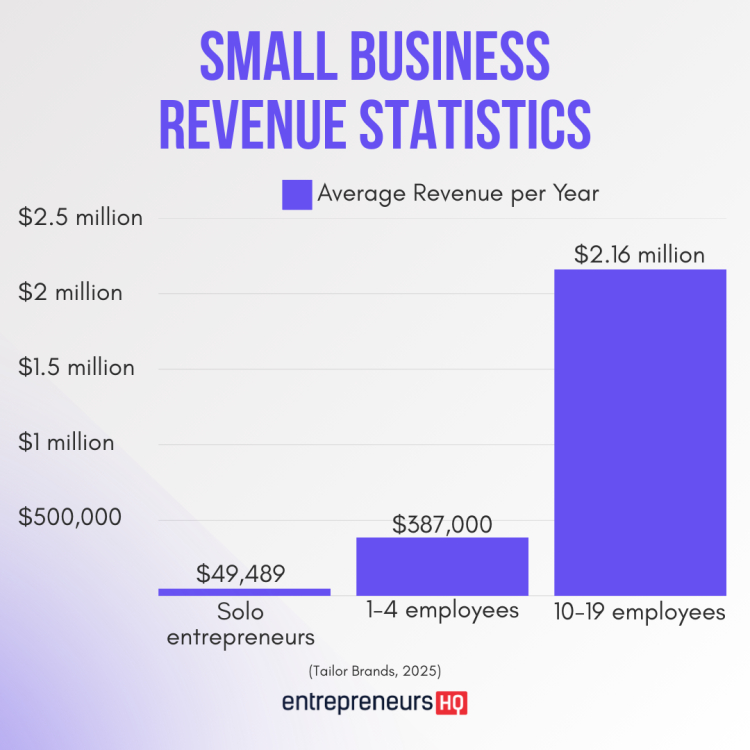
I think the period between 1 year and 5 years is the most treacherous one because that is when you are supposed to build systems, standardize services, and solidify ICP and delegate the fuck out of the business. Without that, the founder fatigue will be too much. The emotional decisions over years will just rot you inside out. I think the failure to systemize is what takes businesses out during the period we are talking about. Hopefully, you are systemizing something that is financially viable. Plus delegation is really cool! Down below, I have attached an infographic that shows how firms with more employees generally have greater revenue. And it’s a greater than sum of parts type of arrangement. Like a solo guy is making around $50K, but 4 people are able to make way more than what would be $50k *4 workers . $387k to be precise.
Another statistic I just saw is…
That means most are not starting from scratch if they are a small business. Everyone is ripping off from existing formulas, either in the form of franchisees or existing things. So if you are small enough, don’t try to reinvent anything. Just go with the flow. Go with what you see with your own eyes that is working. Another way to look at this stat is that 80% of the dataset we are looking at is existing businesses, and this is exactly the dataset that has a pretty decent survival rate even down the line 10 years. So you actually don’t need to innovate. Existing businesses, if run properly, do survive a decade. And if you are looking for exit, then you don’t really need time greater than 10 years to do all of that.
So that means if you look at an existing business, start doing it, and delegate the work, you will make decent money. And 40% of small businesses will become profitable eventually, but 30% lose money, and 30% break even. So you copy something that already exists, hire a few people, and have a way greater chance of earning a lot of money and there is only a 30% chance that you will lose money. Most durable businesses are copies. The 10-year survival rate looks decent because the dataset itself is biased toward copied and continued businesses. That’s the same dataset you should want to imitate.
Why would you ever think of a novel idea ever again? When you know that if you do what already exists, there is only a 30% chance of it losing money. I’m banning my head from ever thinking of any new ideas. Plus forget advanced technology bro, there is not even 100% adoption of barcode and inventory accuracy is above 50% in small businesses. Majority of them use spreadsheets. You are way better off making Excel plugins than some new novel software. 3,600 toggles per day Is the number of times a typical worker switches between apps as per HBR. Even making a simple automation between two or three applications can provide value to them.
The stat that “only 21% start from scratch” basically means: the 79% who don’t are dramatically more likely to survive because they’re avoiding the systematization penalty entirely which most people deal with during the phase between first year and fifth year.
Basically, copy existing business model, delegate, and systemize. Have a proper customer acquisition plan that is viable, and you should be good. Don’t please don’t make any d2c quick commerce for formal shoes-type of bullshit.
It’s like nothing is new under the sun because whatever was new perishes, and it’s only the outliers that survive. So instead of aiming for outliers, go for whatever already exists.
link to Commerce Institute article