See our philosophy is that we are not writing a blog. There is going to be something shown on the screen, so our writing has to be compatible with it. Someone is narrating it, and there are going to be graphics shown for it.
Then the next part is there are levels to this shit. Like, if you just make level one content – something where if someone just thought about it and they would arrive at a conclusion – then that’s not something anyone would want to watch. You have to be at a level two or three where a person even if prompted couldn’t have come up with it themselves. Like if all your content is 1+1=2, then people will leave only after 1+1. We have to optimize for not only the compatibility with visuals but also providing value to users by actually automating information processing and fetching for them. Making things that are visually appealing and intellectually curiosity creating for them.
But on the other hand, people will not watch anything that is beyond 2+2=4. even 2*1 = 2 will drive them away. Any bit of complexity drives audience away. Unfortunately, content has to be something where you behave as if talking with a 5 years who you wanna tell about cool things.
Every domain and niche has infinite content, but only a subset of it can be as simple as 2+2=4. So filtering out things helps you a lot in this, or you end up barking down the wrong tree.
You need content that is:
- Intellectually non-obvious (level two thinking – insights they couldn’t easily generate themselves)
- Cognitively effortless (feels like 1+1=2, no mental strain)
Each sentence has to be designed in such a way that it can have something that is visually compatible with it. Yes, it should be non-obvious, and yes, it should have effortless consumption in a way that people are not repelled by it. And anything above 5th grade level is repulsive threshold
So the writing process is:
- Find the non-obvious insight (level 2-3 thinking)
- Express it in language a 5th grader uses naturally
- Structure each sentence so there’s an obvious visual companion (object, action, comparison, transformation)
Bad sentence structure: “The concept of compound interest demonstrates how exponential growth differs from linear progression.”
- Abstract, no clear visual hook, sounds academic
Good sentence structure: “Your money doesn’t just grow – it has babies, and those babies have babies.”
- Concrete image (money multiplying like organisms), instantly visualizable, 5th grade language
The 5th Grade Threshold: Anything that sounds like it came from a textbook, lecture, or requires re-reading = instant repulsion. The vocabulary, sentence structure, and concepts must all feel like casual conversation with someone explaining something cool they just discovered.
We are essentially writing not for readers, but for viewers watching narrated visuals. Those visuals might be:
- A talking face
- Animation
- B-roll
- An abstract object
So the filters are :
- Whatever you are talking about should be a non-obvious insight
- It should be effortless to comprehend.
- And each sentence should be designed such that there is opportunity to have good engaging visual representation for it.
- That insight (which is the core of the video) is somehow connected to something even a primate would want. Money, power, sex, self-awareness, self-image, etc. Either directly or by extension.
You could have a brilliant, simple, visual insight about… medieval pottery techniques. Fails filter #1. No primal hook = no one cares enough to click or keep watching. But for the same medieval poetry example, how can we make it work? I guess if we are able to connect it to a primal, it would be nice. We are stressed. So it can be:
Are you stressed and wondering about ways you could slow down? Medieval people had it figured out with their poettry techniques.
The pottery itself becomes almost secondary. It’s now a vehicle for delivering something about presence, slowing down, the therapeutic value of working with your hands. It’s all people and their primitive bullshit. Everything else shall only be treated like a vehicle to tap into that. The conscious, the person and its whims are supreme. You shall not treat anything as equal and that means the topics cannot afford themselves to ever be the center. Only the conscious and the whims can be.
I think we don’t get money or connections to people because we are sinners. We commit the sin of not putting the conscious, the people, their whims at the top. We defile them by giving anything else the same gravitas as them. Instead of a thing being in relation to the person, their conscious, their whims, if we make it stand alone, we committed a sin. It’s almost like a court system where the king is at the forefront and everyone is bowing behind him. Anyone daring to stand up is a nail that gets hammered down. To live a graceful, peaceful, and abundant life is to pay respect to the King.
It’s like the person, the conscious, the whims shall be bowed down to by the content and your object that is being talked about shall be bowed down to all other objects that exist. Example of this is you creating a spice brand. You are talking about it in the content but exploring the nostalgia that the person holds. For universe building you can create playing cards that are spice-themed. A whole power structure that there is a king. He’s brought down by his generals and the whole kingdom bows down to the generals and the king too. The brand is simultaneously servant (to the viewer) and master (to everything else). It’s in the middle of the hierarchy.
The Actual Hierarchy:
Supreme: Person/Conscious/Whims (the king)
Below that: The brand/content (bowing to the person)
Below that: Everything else in the entire world (bowing to the brand)
That means everything in the content and the brand is human-serving and everything else in the world is brand-serving.
The Two Laws:
- Everything in the content and brand serves the human – their whims, their stress, their money problems, their status anxiety, their nostalgia, their primitive needs.
- Everything else in the world serves the brand – history, science, culture, other products, concepts, stories – they all exist to elevate, contextualize, and build the brand’s universe.
I think a good proxy for what humans want can be seen through the human emotions or feelings.
| Fear – threat to survival | Anger – boundary violation |
| Disgust – revulsion/contamination | Hunger – need for food |
| Thirst – need for water | Lust – sexual desire |
| Pain – physical/emotional suffering | Greed – insatiable wanting |
| Envy – wanting others’ possessions | Ambition – drive for status |
| Curiosity – hunger to understand | FOMO – missing out anxiety |
| Pride – satisfaction in superiority | Shame – exposed inadequacy |
| Embarrassment – social judgment | Jealousy – relationship threat |
| Loneliness – isolated from connection | Belonging – tribal acceptance |
| Admiration – receiving respect | Contempt – looking down |
| Stress – overwhelmed by demands | Anxiety – uncertain future dread |
| Boredom – understimulated mind | Exhaustion – depleted energy |
| Relief – tension release | Nostalgia – longing for past |
| Hope – anticipating better | Confusion – lacking clarity |
| Awe – overwhelmed by beauty | Righteousness – moral superiority |
| Vindication – proven right | Resentment – accumulated anger |
| Guilt – violated own morals | Revenge – restoring balance |
| Joy – elevated happiness | Sadness – loss/disappointment |
| Excitement – energized anticipation | Disappointment – unmet expectations |
| Frustration – blocked goals | Gratitude – appreciating gifts |
| Regret – wishing different choice | Anticipation – expectant waiting |
| Surprise – unexpected occurrence | Love – deep attachment |
| Hate – intense aversion | Trust – belief in reliability |
| Betrayal – violated trust | Confidence – belief in ability |
| Insecurity – doubting adequacy | Superiority – better than others |
| Inferiority – worse than others | Validation – confirmed worth |
| Rejection – excluded/dismissed | Power – ability to control |
| Helplessness – no control | Freedom – unrestricted choice |
| Confinement – trapped/limited | Achievement – accomplished goal |
| Failure – didn’t meet standard | Comfort – ease and security |
| Discomfort – unease/irritation | Peace – inner calm |
| Restlessness – agitated motion | Satisfaction – desires met |
| Craving – intense wanting | Contentment – peaceful acceptance |
| Discontent – current dissatisfaction | Inspiration – energized possibility |
| Despair – complete hopelessness | Fascination – captivated attention |
| Indifference – no interest | Urgency – time pressure |
| Procrastination – delaying action | Determination – committed resolve |
| Apathy – emotional flatness | Optimism – expecting positive |
| Pessimism – expecting negative | Certainty – confident knowing |
| Doubt – uncertain questioning | Control – directing outcomes |
| Chaos – overwhelming disorder | Respect – esteeming worth |
| Disrespect – dismissing worth | Inclusion – part of group |
| Exclusion – kept out | Abundance – more than enough |
| Scarcity – insufficient resources | Security – protected from threat |
| Vulnerability – exposed to harm | Dominance – power over others |
| Submission – yielding to power | Novelty – fresh experience |
| Familiarity – comfortable recognition | Growth – expanding capability |
| Stagnation – stuck without progress | Clarity – clear understanding |
| Overwhelm – too much input | Acceptance – allowing what is |
| Resistance – fighting what is | Release – letting go |
| Tension – held pressure | Momentum – building motion |
| Inertia – stuck stillness | Connection – linked to others |
| Isolation – separated alone | Purpose – meaningful direction |
| Meaninglessness – pointless existence | Competence – capable skill |
| Incompetence – lacking ability | Recognition – being seen |
| Invisibility – being ignored | Justice – fair treatment |
| Injustice – unfair treatment | Fairness – equitable distribution |
| Unfairness – inequitable distribution | Order – organized structure |
| Disorder – chaotic disorganization | Harmony – balanced elements |
| Discord – conflicting elements | Ease – effortless flow |
| Struggle – effortful difficulty | Mastery – expert skill |
| Inadequacy – insufficient ability | Elegance – graceful refinement |
| Clumsiness – awkward ungainliness | Vitality – energetic aliveness |
| Depletion – drained energy | Expansion – growing outward |
| Contraction – shrinking inward | Lightness – unburdened feeling |
| Heaviness – weighed down | Warmth – emotional heat |
| Coldness – emotional chill | Softness – gentle approach |
| Harshness – rough intensity | Gentleness – tender carefulness |
| Aggression – forceful attack | Playfulness – lighthearted fun |
| Seriousness – grave importance | Spontaneity – unplanned impulse |
| Rigidity – inflexible structure | Generosity – giving freely |
| Stinginess – withholding resources | Humility – modest self-view |
| Arrogance – inflated self-view | Patience – calm endurance |
| Impatience – irritated urgency | Forgiveness – releasing grudge |
| Grudge – holding resentment | Empathy – feeling others’ emotions |
| Calm – peaceful steadiness | Panic – overwhelmed terror |
| Serenity – deep tranquility | Turmoil – inner chaos |
| Bliss – extreme happiness | Misery – extreme suffering |
| Ecstasy – intense pleasure | Numbness – emotional disconnection |
| Alertness – sharp awareness | Drowsiness – sleepy dullness |
| Vigor – energetic strength | Weakness – lacking strength |
| Hunger for knowledge – drive to learn | Ignorance – lacking awareness |
| Enlightenment – profound understanding | Delusion – false belief |
| Lucidity – clear perception | Fog – confused cloudiness |
| Awakening – coming to awareness | Slumber – unconscious sleep |
| Transcendence – beyond ordinary | Mundanity – ordinary dullness |
| Aliveness – vitally present | Deadness – emotionally flat |
| Presence – fully here now | Absence – disconnected/elsewhere |
| Fullness – complete satisfaction | Emptiness – hollow void |
| Wholeness – integrated completeness | Fragmentation – broken pieces |
| Integration – parts becoming whole | Disintegration – falling apart |
| Emergence – something new arising | Decay – deteriorating breakdown |
| Renewal – fresh restart | Birth – beginning existence |
| Death – ending existence | Transformation – fundamental change |
| Stasis – unchanging sameness |
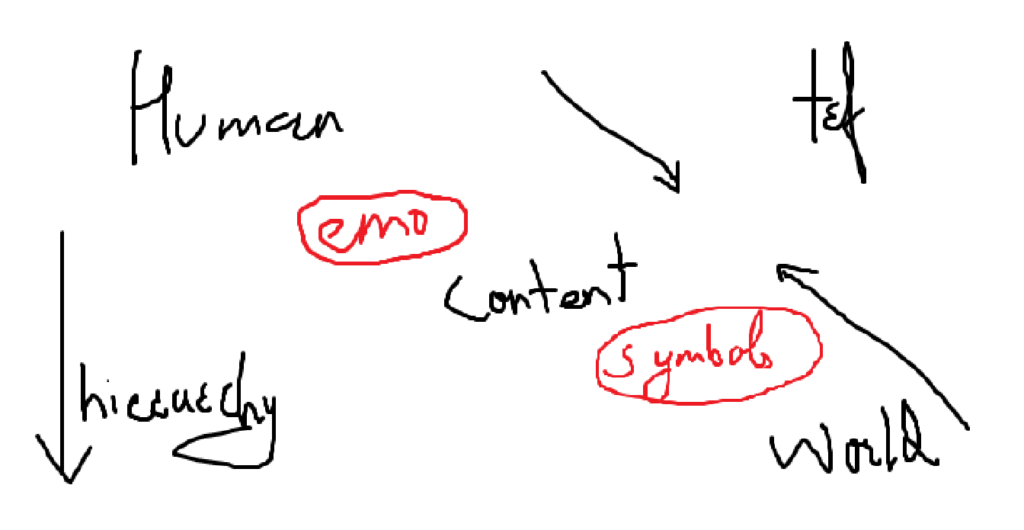
So any qualifying script is equal to any of these emotions and objects relation to these emotions . These emotions are kind of the ambassadors for the human themself
The hierarchy is:
- humans
- content/brand
- the world
But content is the point where we are trying to create something. So from the human side, emotions come down and from the world we bring in symbols that are compatible with the emotions and the humans we are after.
As a content creator you are standing at the middle layer and you are the bridge between the three worlds of the human and the world and the innate object that content/brand itself is. The brand/content itself because you might have a niche that you need to cater to. You might be a sleep-oriented brand or cooking-oriented brand so you need to talk about that from the lens of humans only and subjugate everything in the world and extract symbols from it for your brand/content.
If I have anything to say, always respect the hierarchy we have going on for the human themself. Make sure you extract proper resources from the world and create a good mix at the center with your own brand. Respecting the hierarchy is the primary condition to even have a system; you can later then optimize the combination of different things from world, the brand, and the humans themselves.
You have to imagine a world where if the god is not respected, the universe just ceases to exist. You respect the god in every action you take and now you have this world that exists and will continue to exist because you respect the god. Subjugate the world and extract its resources.
Marketing, politics, money making, influence: this is literal human worship. You’re literally studying the god (human), learning their desires (emotions), building altars (content/brands), and making offerings (symbols from the world arranged to please them). And the most successful people are the most devout worshippers. They don’t question whatever the God wants. They don’t put them on equal footing with the God’s whims. They just listen and serve.
I would like to call it the HECBSW Framework. Humans > emotions > brand/content > symbols > the world. We are here to worship the humans, and your duty as a devotee is to create brand/content using emotions and symbols that our humans would like.
I’m very intrigued by the human worship thing I said. What is the scene and how you committed?
The sin is giving anything other than human consciousness equal standing in your hierarchy. It’s treating a subject, topic, symbol, or idea as if it has inherent value separate from its service to human emotional needs.