I have come to understand that stories are just collections of escalations and de-escalations. There is a premise setting then there is escalation that goes on for a long time. After that there is de-escalation and then we are back to the phase where we need another period of premise setting.
A nice way of thinking about what to do in life, as I saw in a YouTube video, was that you are not supposed to do what your dreams are but what your tools are. If you are surrounded by business people and Bloomberg terminals, it would be wiser for you to use those tools to create value rather than thinking that ‘Hey I should become an astronaut.’ Dreams are valid but you will have an easier time using what you have at your arms’ length.
I think the same goes with the storytelling. Whatever you are setting in the premise, you have a lot of rich details in that:
- The surroundings of the character
- The characters themselves
- Their archetype
- And whatever else you have set in the premise
For example you are writing about a 23-year-old guy moving to a new city. Even that gives you a lot of leverage to create escalation. What does the 23-year-old care about? What can go wrong with moving into a new city? What does one want to do in a new city and what can go wrong? What can stop us from doing that? What bad things can happen in a new city? Just based on that simple sentence that had a subject, a verb, and an object, we were able to figure out what tools we have so that we can cause some escalation.
Let’s say the 23-year-old tried to move there. He is relatively young. Of course he will be very impressionable. He will be still very closely connected and kind of dependent on his parents. Another point is, as characteristic of 23-year-old guys, he might be very well connected to his mother so that connection becomes a leverage in case you ever want to escalate the story. Him being impressionable increases stakes with side characters because they can lead the story anywhere. So each thing in your premise has a long list of details.Those become your tools that can be used to further the narrative.
In any story 20% would be premise setting, 60-70% would be escalation, and de-escalation would be just the catharsis. There are a lot of escalations, some major ones, some minor ones. It’s like a graph of price stocks, right? Sometimes it’s sideways; most of the time it goes up and when it goes down it comes down rapidly.
I think we can do that for almost any form of media, no matter what the duration. I think we can do this even on a sentence level.
Another theme I saw in short stories was that, at the start, they will have a premise; then there is an escalation; then de-escalation; another premise setting; then another escalation, de-escalation. There are multiple premise setting periods, right? They will bring back things from previous escalations or premises into the current escalation so that the whole story becomes cohesive. All the characters, the environment, the emotions, the nitty gritties; they all keep looping in the future. Not always but it is a tool I have seen being used.
It’s like you’re on Amazon. You keep adding things on to your cart. You use them but then you see your purchase history from the past and say, ‘Hey this was useful. Let me use it again.’
Essentially the story you are writing has a lot of things in it, and those things have a lot of details. You can escalate, de-escalate, or set a premise around those and you can reuse those also. No compulsion to always keep bringing something new. That might make your story feel disconnected or that the past has no stakes.
And when should the escalation happen and which tool should be used? Well, that is just based on the writer’s vibe. This is the best practice basically, but it’s not a tool that will deterministically tell you what should happen in each story. It is up to the writer to decide what to do.
story needs escalation
So truth in itself can be a story or if the truth does not have sufficient escalation then you have to introduce it yourself. You can do it by forecasting the future or making assumptions, introducing slippery slopes or vivid imaginations or examples or parallels with other things. No matter what you are dealing with, you cannot let it be bland; you have to introduce escalations even if the thing itself does not possess them internally.
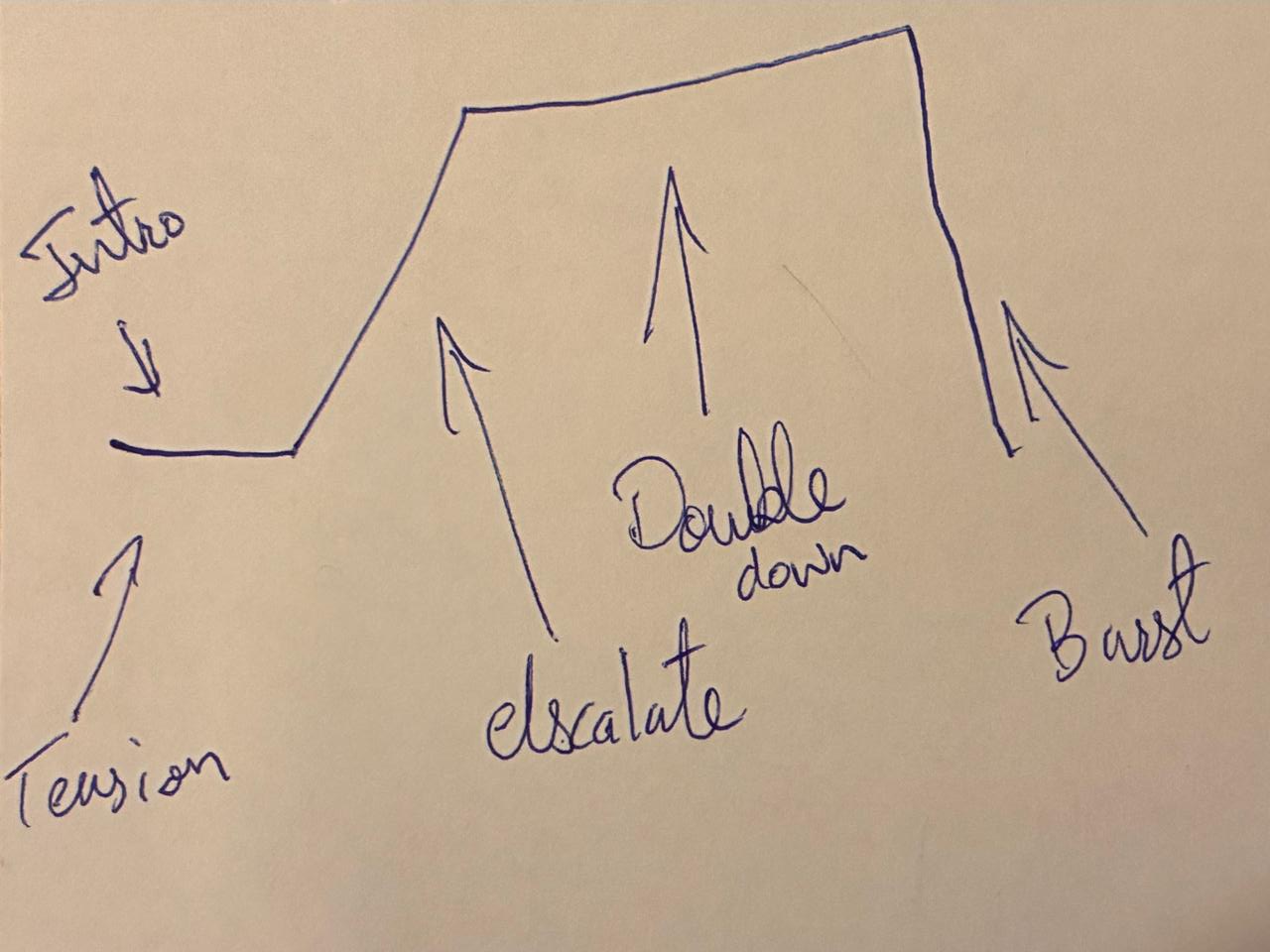
Example from one of the one-minute short stories I saw on YouTube