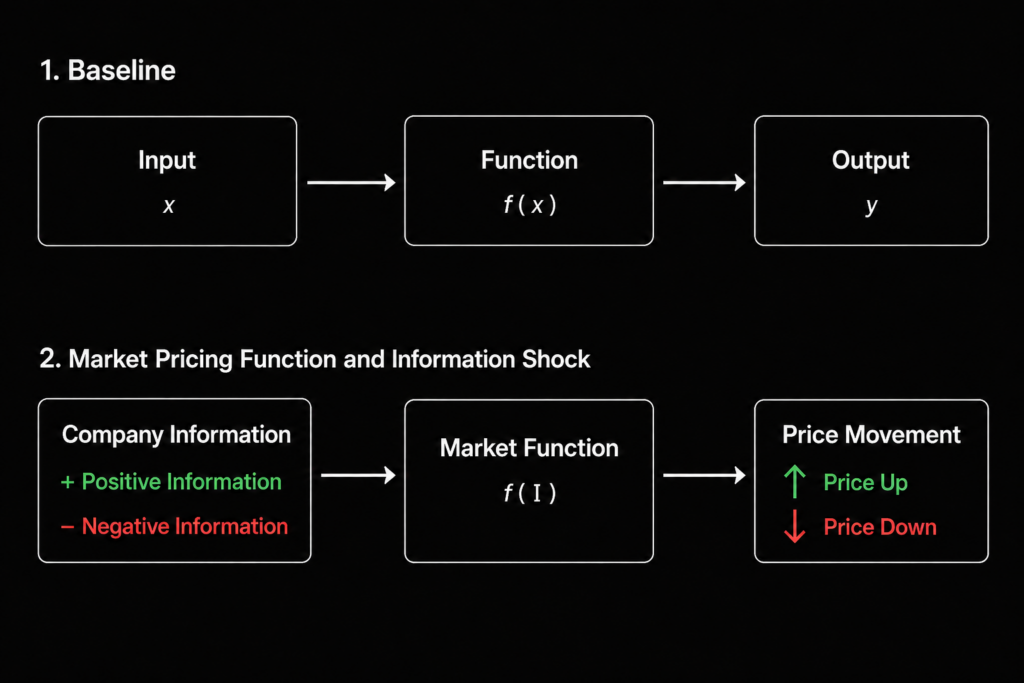
When we have mathematical functions, you have an input, the function does its thing, and then you have output.
Markets can also be seen as a mathematical function which takes in company information and country surrounding it and turns it into a numeric price.
So why does the price change?
- The information might be changing.
- Anticipation of change in material information can also lead to that.
{We have seen this in terms of merger, that announcement of merger rallies up the price, but not fully as if the merger has been completed. In case the merger falls apart, there is an opportunity to short it.}
But information does seem to be playing a vital role.
Market mechanics such as buying, selling, liquidity, etc., can have temporary fluctuations in the short term over the prices, but that is more of a bug than a feature. Information is the primary source of price.
There is tons of information available around a certain security. Not all of it can have equal weightage. So when we are pricing the security, we have to decide what weightage do we give to different information and what is the shock value of its change.
This is why information theory and Shannon’s bits are prevalent in quantitative trading.
Known information has different weights, but those weights might not be static. Future information is weighted in terms of the probability of it happening.
So based on this, you should be making a trade only when you know known information is going to have its weights changed, future information is going to have its probability change, or you have a completely new piece of information in your hand.