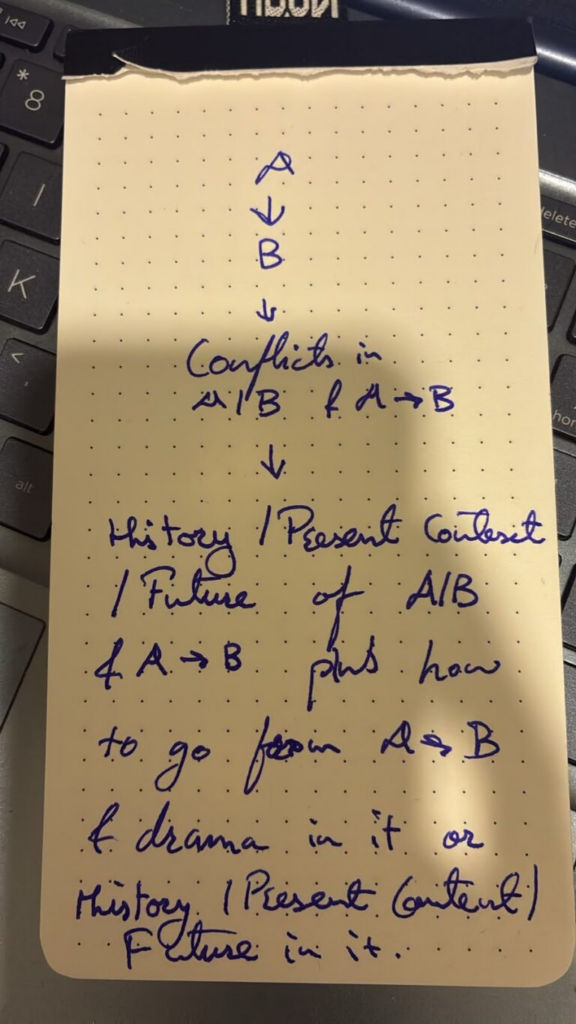
Basically, we know the story structure I have accepted till now is okay. You have a starting point A, then point B that comes after it, and you talk about the conflicts that reside within A or within B and the transition from A to B. Then you talk about the history, present context, or future of A or B. And A to B, plus how to go from A to B, and the drama in it, or the history, present context, or future in it.
Okay. Even with the A and B thing, all I am trying to do is talk with the world. Never forget: all conversations are one-to-one. Mass media conversations as well. A or B are things that people will want to hear about. Gotta keep spectacle, tutorial, and explainer in mind when I’m doing that.
Basically, we know that tutorials and explainers work well for audiences that are invested or curious, but most of humanity is surface-level and would rather prefer a spectacle. So, to go ahead in life, you gotta talk with people one-to-one or deploy media. Success is inevitable via media. My media is going to talk billions of times and cause billions of transactions. I’m gonna make media and talk with the world.
And within this, I have come to realize something about processes and snapshots. Okay, so there is point A, then there is point B. Just talking about A or B is like sharing their snapshot, and going from A to B is about a process. There can be many processes within A and B that can be talked about as well.
So, it is also beneficial to share your personal snapshots and processes too. So go on, you are the artist. Now think about the A’s and B’s. Make media that you would watch and that millions like you would watch. They will join soon. That’s how you talk to millions of people and win the world.
All I should be focusing on now is: what are cool A’s and B’s, and how can we make a script out of this? But how do I do that? Whatever. I’m going to make media so good that I will be my own boss soon.
What if, with these videos, I am just talking to myself? I bet that will increase the standards of quality and make topic selection very smooth. A HyperLogLog video that I would watch. How do I convert things into what I personally would watch? This can help in direction, idea selection, and storyboarding too.
I shall create spectacles I would watch in my media. Let’s be self-serving with our art and capture millions like us. You create media because you want to express yourself and talk with the world. When you are writing a script, think: who are you showing this video to? Your media is talking to someone, and it should have intent and direction behind it.
Well, isn’t that the best analogy? Photos are snapshots; videos are a series of snapshots. Tell me which one has more share in the attention market. But iconic photos do have their place too.
But I see. What kind of photos get attention? Browse through a magazine and you get what I mean. It is usually photos where there is a lot of aura farming, sexiness, beauty, horror, or simply awe-inspiring things happening.
I might watch a two-hour hiking video that is really slow, but I’m not really excited to watch photos of the same hike for two hours. And people are nosy. A series of personal snapshots can also boost things. There is no need for only worldly things to be discussed. One’s personal snapshots are worthy of being shared too.
So make reels on Insta and talk about the process of making those on YouTube.
We live in a world of time. Thus, we keep moving from point A to B in time, which leads to changes in things, and thus everything is part of a process. Everything can be seen as a process. From an attention point of view, it feels lethargic to see things as a snapshot as the sole thing.
A series of snapshots is different. A series of snapshots from different contexts and parts of processes creates something fun. People get bored with one thing pretty quickly. Processes and cool snapshots help.
Maybe the dumb thing I have been doing with regard to media is optimizing for production rather than for what I would watch personally. I should make things for my own liking.
Well then, to be honest, what videos do I even watch?
It’s mostly really cool spectacles, really awesome vibes, sometimes some motivational bullshit, sometimes random information, and a lot of funny videos. I also have a liking for absurd videos where it’s so incomprehensible that both the creator and I know the point is not really to understand anything, but to have this experience of watching it together. Really vibesy, you know.
Then I should think about what makes me watch an explainer.
The explainers I watch usually start from scratch. They don’t require me to hold any context already, and they build from zero to one. They are pretty intuitive. I usually watch explainers about complex things with a relatively low pace of talking.
But the point to focus on here is that I don’t like being explained really simple topics. Nor do I watch anything really complicated. I don’t want to watch an explanation of super-complicated stochastic calculus just to derive some option price. That’s too much.
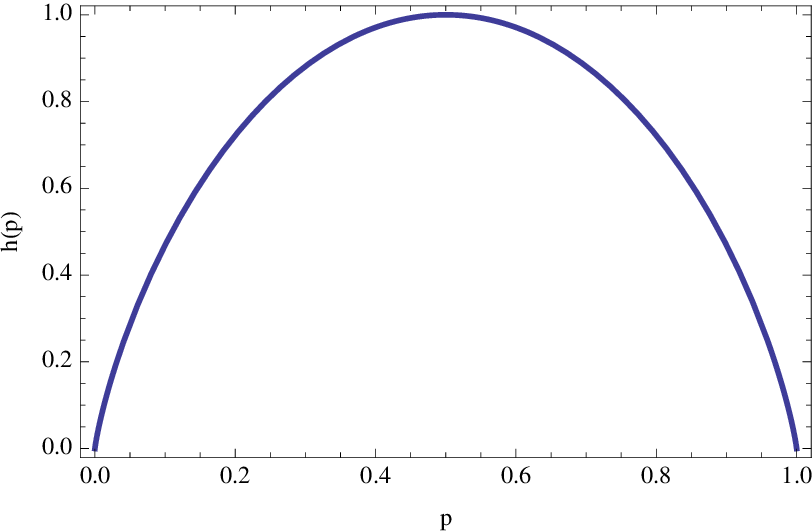
In a sense, have to share snapshot or processes and their context in a way that it is creating some entropy in the viewer’s mind that hey, this is new information and I don’t have much clue about what’s going to happen next. It’s kind of interesting. I think here again we can see the Shannon’s curve applying again. That if you make an explainer about something really really obvious. Then it is not worth watching because there is no information transfer. Or if you make something it about something so complicated that I have no idea that I might be able to use it or grasp it, then again it’s skip. You have to create just enough certainty that someone might think, hey, with the current information, if I watch this, I might be able to get it and it’s useful, or hey, there is enough information in this video that even if I don’t know something, this will just explain me. So you are avoiding the ends and the middle of this graph.
I think this exactly is the job of media. I finally get it that it is supposed to signal to the viewer that hey, this thing is something that you don’t know, but you can get it if you watch this, and it is going to be worth it. Because either it’s useful information or you are a nosy person or it’s just primal thing. Invoking just enough curiosity that they wanna watch even if they know or don’t know the thing.
I think this is where thirst traps do so well because people just easily anticipate what’s coming next or maybe in terms of get-rich schemes or really rich visuals also it just signals something is right around the corner. For explainers it is harder to manufacture because you have to manufacture a feeling that. Really cool understanding is right around the corner, and that understanding is worth it for you. I guess that’s by explaining things related to face, body, money, status, or things we primaly desire is a good strategy.
The viewer is constantly asking, usually subconsciously:

“Is there something here I don’t already have, can I realistically get it, and will getting it feel worth the next few seconds?”

Good media answers all three very quickly.

It signals novelty:
“there is information, experience, gossip, beauty, danger, usefulness, or surprise here that you don’t fully possess yet.”

It signals accessibility:
“you will not need a PhD or twenty minutes of setup to get the payoff.”

And it signals reward:
“when you get there, it will be useful, satisfying, funny, sexy, shocking, beautiful, clarifying, or socially valuable.”

That is why curiosity alone is not enough. Maximum uncertainty can just feel like noise. The viewer needs some confidence that the gap is closable and that closing it is worth the effort.
Even if it is something abstract, you have to make your explainers primal. You won’t go in front of a streamer and just start yapping about some. Information related to CPU threading. That’s just dumb. You are not having a one:one conversation with that guy. Instead, maybe you can say, hey, whatever you are doing is very similar to that threading. Damn, you are smart or something like that. But that is also way too abstract. Maybe you can say hey, maybe CPU threading saves a lot of time and energy by doing this. I think you can also apply it to your business and on way more. Maybe now it’s primal enough.
That means you actually have to treat things as a one:one conversation, and then think about how you are going to make it primal for that one you are talking with. You have to embed an audience into your media. Because depending on the person you are talking to, the same explainer can change the language a lot.
Take an example of caching. You can have a really cut and dry explanation that is really generalized. But if you are talking to let’s say a business owner, you can just say if a customer is asking the same question hundred times, just put it as FAQ. If you are talking to a student, then just say if you are revisiting the same page in a bulky notebook hundred times, just make a flashcard.
Yep, you have to figure out a way where the abstract becomes something you would say in a one:one conversation with someone, and that it contains enough information entropy that they pay attention. Basically, to make someone pay money, you have to give them convenience or novelty or status. And to make someone pay attention, you have to promise them enough information entropy, but resolution and payoff that is really really achievable.
relevant + unresolved + resolvable + rewarding.
Something is relevant if it addresses the ambient and ever present desires that all of us have: more energy, more rest, more money, more safety, and then. You deliver some communication that invokes one of those and is vague enough that you are interested but not complete enough that. You can skip, but it is also not too vague so that they don’t think it is unachievable. Of course, since it was related to one of the ambient desires they had, it is going to be rewarding. I know I talk about thirst traps or get rich quick content too much on this fucking blog, but hey, those are just that.
The viewer carries around a bunch of ambient wants all day: more money, more energy, more rest, more safety, more control, more attractiveness, more status, less uncertainty, less wasted effort.

Media becomes relevant when it touches one of those wants.

Then curiosity comes from incompleteness.

You show enough that the viewer can predict the category of reward, but not enough that they already possess the reward.
Yes, it’s like I think I want the audience to be founders and business people. Like I I am very inclined towards business. Like I would love to watch videos that just keep me in a zone where I’m focused on entrepreneurship and I keep getting these hits. Of how I can get better that can keep me motivated. Of course, not too cheesy or too cognitively heavy. After all, I am on fucking Instagram Reels trying to have a good time. But you know what I mean. A KV cache video can do that. That hey, you don’t need to always do some process. Maybe you can save the process progress.
Okay, so first of all, there is a information generation system ,which by default has levels of information and entropy embedded in it.
For example, if it’s four red balls in a box, then it is high in high amount of context and low amount of entropy because it is always going to be red ball if you pick one. If it is like two red balls, two blue balls, it is medium level of context and highest amount of entropy because you just won’t know anything about. What ball is going to come?
And then, if you are observing it and someone comes and tells you something, it’s not related to the balls. There is no information.
If a ball is drawn, you get new information. If it is other four red ball box and you got to know that it’s a red ball, then it’s not going to cause a lot of Information change, or structural change to you.
Now imagine there is a box with ten red balls and one blue ball, and based on that information you took some decisions in favor of getting a red ball. But if it was like ten red balls in one blue ball and somehow one blue ball was picked up, it is going to be pure information because it is against what you thought might happen. And that information will transform you.
So it has a data generator, your beliefs about that data generator and actions you took because of it, and communications coming in about that data generator’s output, and that communication causing you to update things. And if the communication does not contain any information, it’s irrelevant. If it is changing too much, then it’s not relevant also.
So we are talking one is to one with people. They are going to observe some data generator, and we are here to tell them something about the data generator or its output that is going to be. Highly unlikely, according to what they thought and took decision based on.
It means if you are talking to a potential customer who thinks you cannot have really cool haircuts in the city of. Amravati. Go and tell them, hey, this salon is really good. You should check it out. Now that is new information that is going to most probably cause them to go visit that salon.
So each media is about challenging the perception (and associated decisions/ behaviours) of people regarding some data generator (world, politics, status, products, business, etc) and giving them pieces of information that transform them enough that they can’t look away until that gap between what you told them and what they think is closed.
Like everybody wants to be charged fairly, but if you tell a AI user that you are being charged based on tokens, but every model has a different tokenization algorithm, so how exactly are they being charged? So that. creates a bit of shock that hey am I getting cheated? How are they charging me?
There is a generator → the viewer has a model of that generator → that model produces expectations and behavior → media introduces an observation that clashes with the model → the viewer now has unresolved uncertainty → the media closes that gap by giving them a better model.
creating gap between
Okay, they have a belief or perception about the data generator, so entropy is low. Then you tell them something that breaks or takes them away from that perception, and in that moment, entropy rises because now it could be anything. They had a belief and now they don’t, and then you deliver them information that helps them settle into a new model. So if if the communication you give If it contains so much information and it is very disruptive to the old model, then they would flatly reject it and go back to their old one because it’s too much effort. But if it’s like if you are telling them to go from this street light to next street light, they will most probably do it.
belief (low entropy) > comms that disturb it > Now it could be anything (high entropy) > you give new info to form new belief (new low entropy) > repeat
Someone enters your video already carrying a model of something. “Databases count users like this.” “AI companies charge me by tokens, so the accounting must be straightforward.” “Caching is some obscure computer thing.” Their model gives them reasonably confident expectations.

Then the media introduces one observation that their existing model cannot comfortably explain.

“Every model tokenizes your text differently. So what exactly does ‘paying per token’ mean?”

Now the old model is no longer sufficient. You’ve raised uncertainty. The viewer has a little unresolved hole in their worldview. Crucially, though, they can see the shape of the hole. They haven’t been dropped into random noise.

Then the rest of the video earns its existence by closing that hole with a better model.
Plus, you know, now we don’t have to judge ideas by complexity. We have to judge them by the amount of entropy they generate. A highly complex media idea can generate zero entropy, or a simple one can generate high amount of entropy. Just that we need to manufacture enough entropy that we compel them to watch the rest of our shit to close the gap in their head.
What does my intended viewer currently expect this system to do, and what observation can I show them that their model struggles to explain?
So you take them from state A to B, and at B you take them through the same process and take them from B to C, and you can chain them these ways. So instead of trying to transport them from A to Z, you can just take them A to B to C and so on. It’s easier to convince someone to run from one street lamp to another than to convince them for a fucking marathon.
And kids, this is how I became so good at creating media. In case you are visiting this blog from future, you can visit others and see how they shaped me to arrive at this point where I am able to identify ironies in worldviews at an individual level. And use them to create media. If you are visiting other blogs, keep in mind I’m using a speech to text tool of my time, and it’s not particularly great, and I can’t be bothered to check the punctuation or grammar. So maybe use your AI models to summarize this or something.