If we go by Peter Thiel’s definition, technology is something that lets you do more with less. So you can think of Efforts to get an output as a linear or exponential chart, but after introduction of specific technology, it turns or tries to turn into logarithmic curve.
So technology is here to flatten the effort.
In real world we have physical innovations that can become technology. But those physical innovations can be patented, and an entity can hold the supply of it and capture all the value it generates because of the time and energy savings and the increasing volume.
In software, we also had a similar thing till now that only few people are able to create technology that reduces the time complexity of solution. Like instead of going through thousands of papers, you can just have a information management system, right? And you can search through them efficiently and stuff like that. Only few people were competent enough to make it and supply it and host it on scale, but now with AI we will soon see that AI will be able to autonomously do it. So up till now technology and value capture were synonymous. If you own the technology, you own The value it will generate.
But what about a future where software can be reverse engineered within moments after it is exposed to the internet, or anyone with means such as a LLM? That means in software we will see a lot and lot of technological innovation but really hard time to capture it’s value.
While the physical world can be spared from all this since we already have copycats in China and that it does destabilize a lot of companies living off patents and stuff, but still it has not totally collapsed the industry.
Counterfeiting is a huge activity, but it pales in comparison to the normal commerce. But piracy is something that dwarfs normal digital consumption. I believe one time music studios tried to sue some pirating company, and the amount came up way bigger than GDP of a lot of countries. It’s like piracy enables consumption. That would have never happened, but counterfeiting still has to have money backing it up. If there is. Basically, it’s not infinitely replicable, right? A fake Gucci bag still costs money, but a pirated song doesn’t.
So we had a business model in software where it created a technology. It was able to capture the value, and it could render its benefits infinitely if it just keeps spinning up a relatively cheap server compared to the benefit it was giving. Now the benefits still exist, but you are just not able to capture the value.
Being infinitely replicable drove valuations during the SaaS era is the same thing that is going to cause a lot of harm to it. In future as well. So software has no value in future unless it is tied to something physical.
So software is going to keep generating value into future. But a proprietor is not going to be really able to capture it like they traditionally did during 2000 to 2025. The models are going to change. And I mean, a lot of value can be captured by the LLM providers themselves that hey, whatever software you need it will be spun up on the spot so don’t worry about it. So people still would have a incentive to keep paying for LLMs because What is software they need? It will be made on the go. Does that create a bigger market than what exists as SaaS today? We will get to know soon.
World is full of inefficiencies. Okay. There’s definitely going to be more software in future than there is right now. Because as people interact with chatbots, as they become cheaper, it is going to spin off artifacts for them that they keep using. The amount of software is just going to increase. But there is not enough. Leverage for anyone to capture that value. It’s just going to exist for free. Just like making a copy of a file on your computer, you can just pin some software off. UK government spent one seventy five. thousand pounds to develop a snake game. Now you can generate that in just like ten cents worth of tokens. It’s incredible what can be replicated now. One mental model to view it is that imagine There is a pen drive that contains everything, and you can just copy stuff from that and put it on your system. That’s essentially what an LLM does. It has everything inside it, and it can summon it on your device. So. You become one of those bootleg DVDs which has like hundreds of games in it. And we know the games that have pricing power are ones which are solo titles. So To command any value capture, you have to be something that LLM cannot build. Because if you are part of the unlimited pen drive, you’re done. Another problem I notice is that This thing is able to replicate videos as well. That it can just take any media and make a one:one replica. So if you make something extremely creative. It will have value because no one else, with the tools of that era, was able to make it up to that point. But just four or five days later, you will see copies of it all over the internet because LLM was able to replicate it by reverse engineering. So this is looking a lot like quantitative trading where you come up with an advantage. For a short while, and then that advantage gets washed up. But on the other hand, I also see that humans love sequels. All the money in the entertainment industry is in the sequels. People love world building. People love immersion. People love to have more and more versions of the same thing. There are Brazilian Jurassic Park, Star Wars, Avengers, superhero movies. There are hundreds of comics of same character. There are hundreds of flavors of Oreos and KitKats. People want sequels. So I believe the life cycle of things will go through mutation where time to first copy will decrease dramatcally.
I think then what’s left to do is to become something that CPG brands have figured out instead of seeing a chocolate or fitness bar. or health supplement industry. Big brands have very popular ICPs. Okay. And some ICPS are never served. For example, if you see the magnesium market, the CPG brands might be talking to the generic fifty-year-old who can’t fall asleep, so he just have a magnesium, that kind of thing. But a CPG brand might come and say, hey, we see a cultural shift that a lot of twenty three year olds who are into hustle culture are not able to sleep easily. So maybe we can target those guys as well. So these are very culture and niche aware brands. I don’t know if software has a surface that can do something like this, but I think CPG apps can definitely do this. Especially given how customizable and bespoke software can become now.
Models are such commoditized things, yet someone is printing money using EcoGPT. So it truly might be just about finding niches that are underserved, positioning for them, and targeting them, and being able to charge premium because at that point you are kind of a bespoke service provider. See, if you serve Millions of customer, you are just a mass market brand. But if you are giving a bespoke service to a crowd of hundred people, you’re something else. You might even be knocking on the doors of luxury at this point. You command way bigger pricing power because no one else is doing that for them.
Maybe software is not dead. You know. Maybe the advantage has vanished from mass market because anyone can replicate it and offer it to the same customers. Maybe what is truly left is time operations. Maybe software brands will. Have to learn a lot from CPG brands and go after niche. Maybe you make a ChatGPT but for religious people. Or a to-do list for The chronically late 35 year old on the verge of getting fired. We are going to see software become as tailor fitted as service.
If you start a CPG brand and try to become a generic brand, you are gonna have almost the same margins and the same customers after things have stabilized. Okay, so the market has its demand. and resources and if you transfer it the normal way you’d have normal returns. But someone can go bold and say hey I will take the resources but instead of allocating them to the usual people I’m going to modify the product a bit and allocate it to this bunch of people. So It is essentially a bet that you are going to take the usual resources plus something else, package it a bit differently, and instead of routing it to the usual market, you are going to go for a different TAM.
So it’s like imagine you are in City A and there is a tourist place called City B. You can run a bus line traveling between those like everyone else does, or you can find some remote workers who have work in City C. Now You can take that bus and use it to help these remote workers go to their office two times a week as per their job demands or whatever. I hope I’m able to convey the point that every business has usual inputs, usual processes, and usual target audience. The way to go forward is to take the usual inputs and something special if needed. Change up the process a bit so that you have a unique offering but not too differentiated. And then instead of the usual market, you go to someone else. And hopefully the product and the process and the inputs you used align with this new market. Even better example would be that imagine you are a mouse brand and the usual customers are the office people and the suppliers also have set up their whole manufacturing process around it. You can come along and say hey give me extremely high DPI and give me that mouse. So your product is a bit differentiated. And instead of going to the usual office crowd, you are going to gamers. So your product is a bit differentiated and it is aligning with the different market. So it’s like instead of resources and processes going from A to B, it is going A to C, and it is a bet that C is a more profitable destination for you.
So now entrepreneurship might just be about okay being satisfied with nicheer markets and figuring out what are the A to B routes and can you figure out a A to C route.
Imagine A as a place which collects the inputs and processes it, and B as the first destination. Between A and B, they are transferring the goods using vehicle. We will just call it positioning. So your job is to make sure that you come up with a destination C, a different vehicle than A to B, and maybe if possible, some differentiation in product and process. at station A
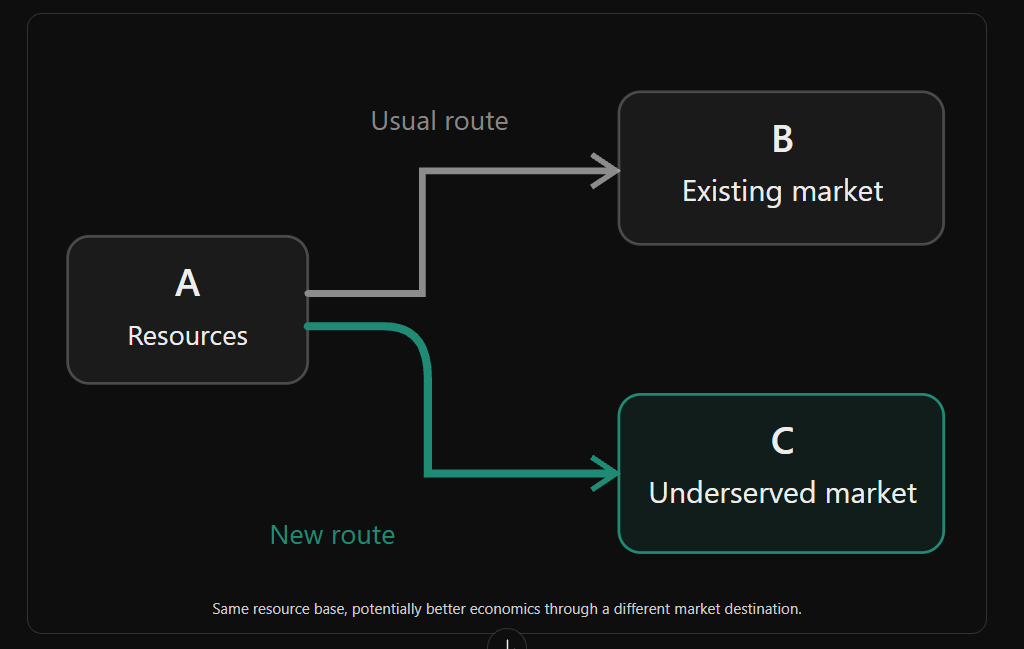
And this is the thing I can cheese, I guess. In in my previous articles, I admitted that most of my big wins, I come from playing in a non-vast bounded game, where I figure out the Pareto move and cheese it till I win. So I think in entrepreneurship also, the cheating move could be just figuring out the A to B, and then. Figuring out the right C and the vehicle to that place.
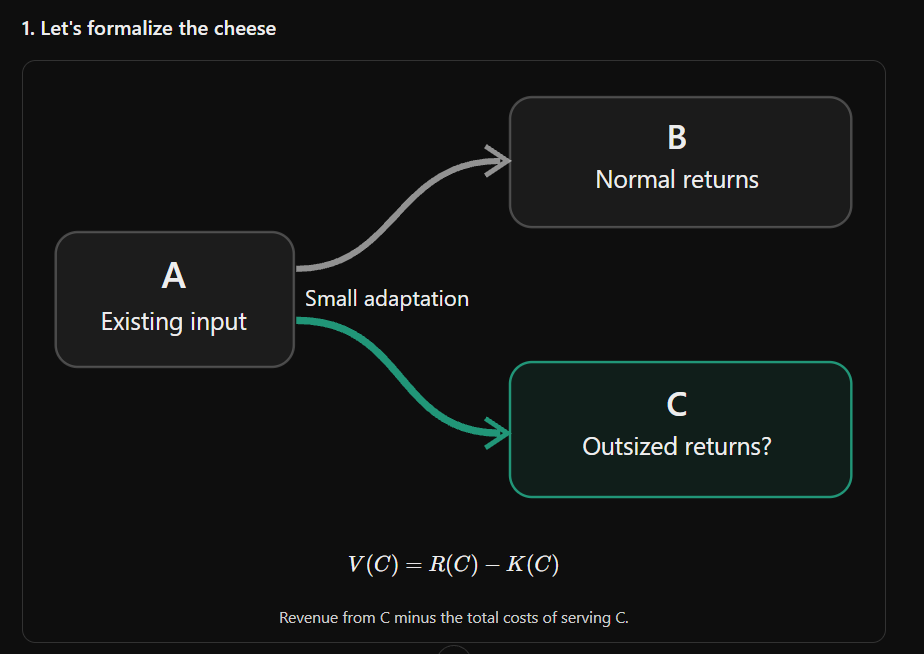
Value of C = revenue from c – cost of c
Even better if somehow we can find a way where it’s like logarithmic efforts but exponential return that the C is such that the efforts we are putting are similar to A but the returns are way too fucking outsized.
This can work for content as well that hey, I’m sure there are a lot of educational videos. But firstly, good thing for us it proves that there is a demand for that concept. But the video they have made it might not be packaged in a way that appeals to let’s say a grandma or a hippie dude in his twenties who has given up on society.So in a way we can see that the A to B thing is happening with content and these destinations like a grandma or this hippie dude can become a C. But first of all we have to see that if the value of C is high enough is is this something where efforts are logarithmic and returns are exponential.
So basically now the thesis is that there are segments of people which have linear or exponential time complexity of solution. Since the current solutions are not tailored for them, so they are not able to adapt it or they just don’t use it. And if I do the A to C thing, I can reduce the time complexity of solution. And if I search well enough, I might end up with something where my efforts would be logarithmic and the return is exponential.
The Mathematical Game
There are two asymmetries to maximize.
First, the customer’s improvement:
ΔC = E(old) − E(new)
Second, the return on your own adaptation effort:
L = Incremental profit from C / Your incremental effort