AI can make stop motion. It can manipulate existing 3D stuff, like if the models exist, and it can create good 3D stuff on its own.
But 3D stuff is expensive. It cannot be bespoke per project kind of thing, right? The economics don’t make sense. But it can be used for assets. Like if you’re creating a world and you’re planning to use that world a lot of times, then fine.
We can have bespoke stop motions per video though, using the image 2.5 thing. Image to a really grippy stop motion for the first two, three seconds. Like you might have a photo. Maybe we can turn it into really good stop motion using whatever lessons we learn by looking at the GOATs.
Then visuals are very replicable now. Story selection and script seem to be the differentiator. We need to first understand what works and how AI can keep finding these things.
Software is no longer proprietary, I believe. Humans, we can reverse engineer any damn software we want. Software can only be proprietary if it has something no one else can copy, like data, users, or state-of-the-art stuff.
What remains truly proprietary seems to be things bottlenecked by hardware, human-mandated involvement, taste, or of course money, if the thing needs money.
So we know for sure AI is bad at ICP and story selection and story writing. Soon enough it will have that too, but until then we can enjoy the leverage/arbitrage.
There is a human-AI arbitrage thing going on here. If AI can do it well and cheap, then for that autonomy and convenience people will do it in-house. So image generation and visuals are gonna be in-house and eliminated unless you are a bespoke artist.
Commerce is going to happen now if you are positioned as the guy for it. Not because you can do it.
But to be positioned for something, you need to know the person, the desire, and the problem that you are tackling.
And I think what I described previously as proprietary is what one should position themselves for. Because if you become the guy saying how to do XYZ with AI, you tell them that, “Hey, you need to do ABC or PQR in a certain way,” then you are on quicksand. You are building a castle on sleeping sand.
Because these AI companies are moving in the direction of AGI, and they are partnering with other proprietary software dealers really fast, like Clay, or let’s say some voice model, or whatever.
So what today needs your advice, tomorrow won’t.
We have to move up the value chain, where we influence what these people even think of AI or use it for.
We have to move above the how and what so that we can get to the why and who.
There is high opportunity cost for everything. Providing signals for what is worth it for you from a time, money, and competition point of view might be more helpful.
I am trying to wow the 22–35-year-old builders and founders. People making shit, people consulting on growth, sales, and media.
Tactical things are losing value fast.
As for last month, if I created some video or HTML using ChatGPT, it couldn’t send me video in chat, right? Then I would ask it to go and upload it on a temporary file system and give me the link, and that was valuable knowledge last month.
But now we don’t need that knowledge because it can just send video right in the chat now.
So useful information last month was tactically redundant now. The why is more durable than how or what.
This has to become more like how to think like a CEO who has infinite things he can do with limited resources. So this is about resource allocation.
You remember that book Thorndike wrote, Eight Outsiders, or something like that?
The era of software engineer or vibe-coder-esque shit is over when it comes to content.
So resource allocation, why, and AI. This is how we wow these people, because shit is expensive, bro.
Also lean deep into psychology. We gotta know people, understand them. Knowing how to do is not enough now. It is about understanding people.
Now that I think about it, all really cool channels are about resource allocation.
Personal channels are you sharing where you have allocated your financial and emotional resources.
All big channels that we get fans of get you invested in something. We do care about them, or what they say, or do, or what they have invested in.
We are also asking our audience to invest their resources in us: listen to us, care about us, buy from us, whatever.
And humans mostly allocate resources to things they are aware of.
We become aware of things through things we are already aware of.
Stranger becomes friend, and then their friend, who is a stranger, becomes our friend of a friend.
So it’s like if something is really strange, we become familiar with it by just being accompanied by it for so long. And then when we know that thing, the things that are associated with that one also kind of have the opportunity to get familiar.
Unknown becomes known via analogy, which of course contains half as what we know. Like this is in terms of knowledge or lessons or whatever.
An unknown brand becomes known by being shown via a known celebrity or influencer.
The unknown shall rely heavily on the known to be paid attention to and become known.
And AI has become self-sufficient enough that it is not a tech problem anymore, but a resource allocation problem.
Resource allocation is a known issue for people who produce shit.
A bum is heavily under-invested or under-leveraged anyways.
A productive person knows the importance of resource allocation and apparent scarcity of those resources.
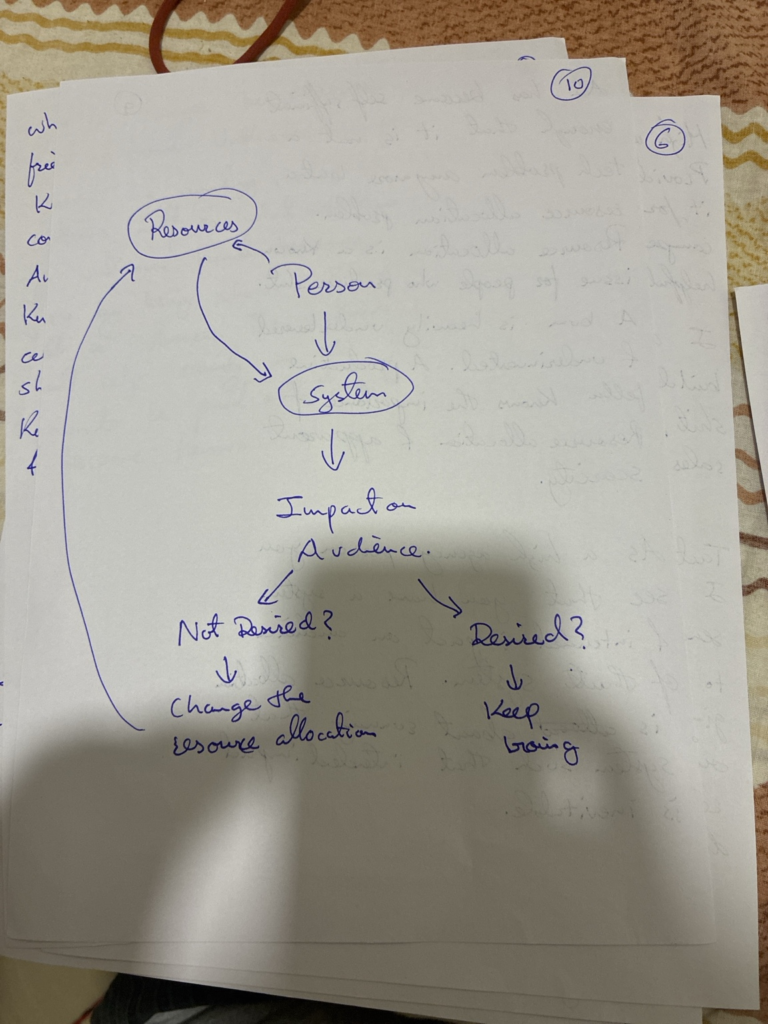
As a high-agency person, you see that you have a system and intended impact on the audience of that system.
Resource allocation is about running that system so that the intended impact becomes inevitable.
Then I have the diagram.
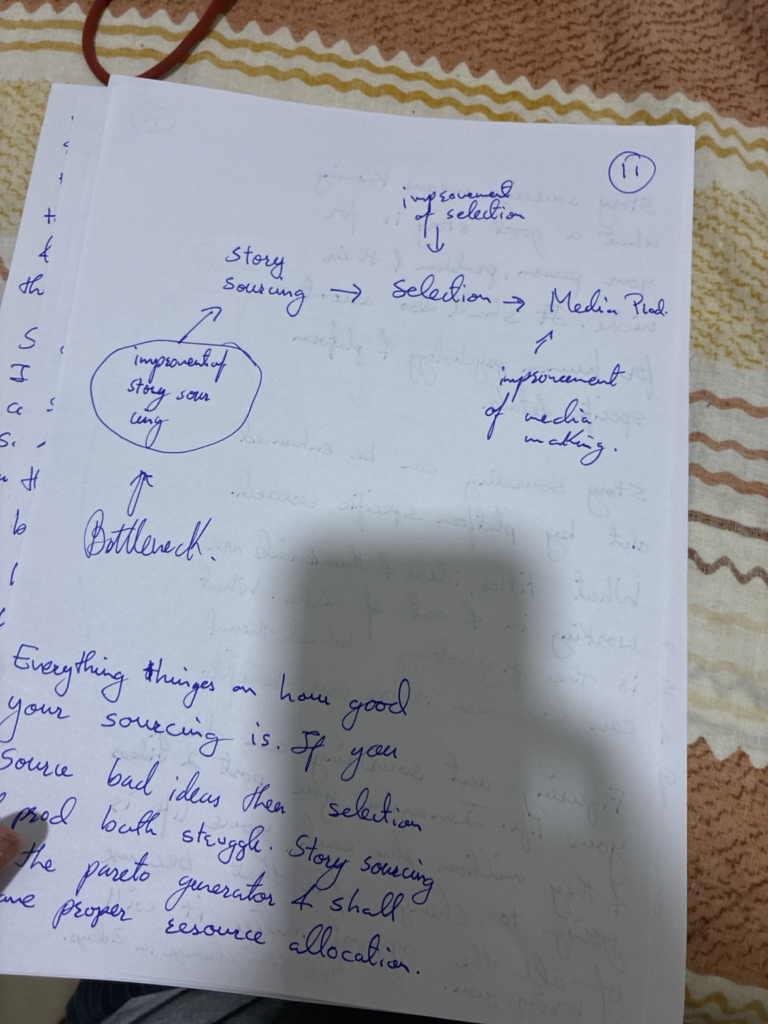
And then finally, what I’m saying is everything hinges on how good your sourcing is when it comes to story.
If you source bad ideas, then selection and production both become a struggle.
Story sourcing is the Pareto generator and shall have proper resource allocation.
Story sourcing means knowing what a good story is for your person, problem, and their niche.
It also accounts for human psychology and platform-specific details.
Story sourcing can be enhanced a lot by platform-specific research: what titles, ideas, thumbnails are working in and out of our niche, what is the psychology behind them, and can we use it for our benefit?
And figuring out sourcing can change your life.
Imagine you post two videos and both of them get millions of views each. Your life is going to change after that because of all the opportunities that will come to you. Companies will want to sponsor you. Startups will want to hire you for media-related things.
Your life can change in two days if you just lock in properly on story sourcing.
For whom is it worth making? Why will they care? Why should this receive our scarce time, attention and money instead of the thousand other things we could make?
It’s like we put in the resources to run the system or modify the system to get better, like get closer to the intended impact. So resource allocation is constantly a problem between wanting to run the system or improve the system, and where to exactly improve it.
It’s like there are four valid states for high agency person. They have their resources, they have their system and they have their desired impact on audience. So if they are getting the desired outcome, then all they have to do is pump out more volume through the system. But if the thing is not desired, then first of all, discovery process in the system that what exactly is causing this. Deviance from intended impact and actual impact, then research about how to fix that specific part, then updating that part and then running production and then seeing again that hey did it work.
So the four valid states are basically:

- Desired impact is happening → exploit.
Don’t overthink it. Push more volume through the existing system. More output, more distribution, more repetition.

-Desired impact is not happening → diagnose.
Find the specific source of deviation. Is it sourcing? Selection? Script? Packaging? Production? Distribution? Audience mismatch?

-Cause is identified → improve.
Research that exact bottleneck, change that part of the system, not everything.

-System is updated → test again.
Run production through the modified system and compare actual impact with intended impact.
┌──────────────────┐
│ Resources │
└────────┬─────────┘
│
▼
┌──────────────────┐
│ System │
└────────┬─────────┘
│
▼
┌──────────────────┐
│ Actual Impact │
└────────┬─────────┘
│
compare with desired
│
┌───────────┴───────────┐
│ │
▼ ▼
Desired Not Desired
│ │
▼ ▼
Run more volume Diagnose deviation
│ │
│ ▼
│ Find bottleneck
│ │
│ ▼
│ Research
│ │
│ ▼
│ Modify system
│ │
└───────────────► Run / test againBasically in the media business, if you are making low tam and vague stuff, the definition of vague being explained in the previous article, you are just setting your money, time and resources on fire. Make sure it is not vague at all for the intended audience and It is not low tam at all. It’s like low tam and vague parts of your title or content. The more they are, the more exponentially dead your media becomes. Like TLDR news has one video called is stramer going to ban X? The underlying thing is very good here. It can be framed as Elon versus UK. Okay, but they went for Stramer and X. Nobody gives a fuck about Stramer. No one cares about X ban because that’s happening in UK. So it’s like Stramer is a low time thing, X ban is a low time thing. And banning apps, it’s like we know doesn’t really happen really quick. It’s really low tam , no urgency there. So they could have made it something like UK versus Elon or something like that to make it high time, but they didn’t. And of course UK versus Elon is still very vague, but at least it’s high time we can figure out the vagueness soon.
Tumbnail being elon vs uk and title as
Can Britain Actually Shut Down Elon Musk’s X?
(https://www.youtube.com/watch?v=mP01GcI6J4A) for example, in this video, he says Honda is bigger than you think. Who gives a fuck about Honda being bigger? Like it’s too vague. Like okay, it might be bigger than I think. Sure, but how big? And can we really quantify that? Okay, how do you know how much size I have of Honda in my head? It’s not ridiculous enough. Okay, see Honda is not iconic enough. And if you have invested all the money in making that video, then you have to. Figure out how to make it relevant for the user. What’s so ridiculous and high time that anybody would want to click on a video, or at least more people than now?
“Honda is bigger than you think” says: please imagine some notion of Honda's size, then imagine that notion being wrong, and trust me that the difference will be interesting.It can be that Honda is also defense contractor. Maybe the thumbnail can be a Honda Jet. And the title can be something like they make tanks and then question mark question mark or something like that something ridiculous. Basically this this thing is already weak enough on its own. The only ridiculous and familiar thing here can be extremely weird or primal objects like. Weapons or something sexual, but we cannot do that on YouTube. So yeah.
Story strength ≈ TAM × clarity × expectation violation × consequence

“Honda is bigger than you think”:

TAM: medium
clarity: low
violation: low
consequence: unclear

“Honda Makes Jets?”

TAM: medium-high
clarity: extremely high
violation: high
consequence: moderate

“Why Did Honda Spend 30 Years Building an Airplane?”

TAM: medium-high
clarity: high
violation: high
consequence/resource question: high

And this also explains why primal objects help.

Weapons, enormous amounts of money, sex, death, power, extreme luxury, giant machines, disasters—these objects come with enormous preinstalled psychological weight.

You don't need to teach someone why a tank is interesting.

A tank is already semantically loaded.

So if you find that some boring industrial company secretly makes tanks, nuclear-reactor components, rockets, submarines, billion-dollar machines, or something similarly extreme, the familiar primal object can carry the unfamiliar company.

The bigger principle is:

Never make the audience finance the curiosity gap themselves.
After going through hundreds of video, I also realized that talking negatively about a low tam thing won’t fix it. Ideally, you should always go for something that is high tam and zero vagueness.